
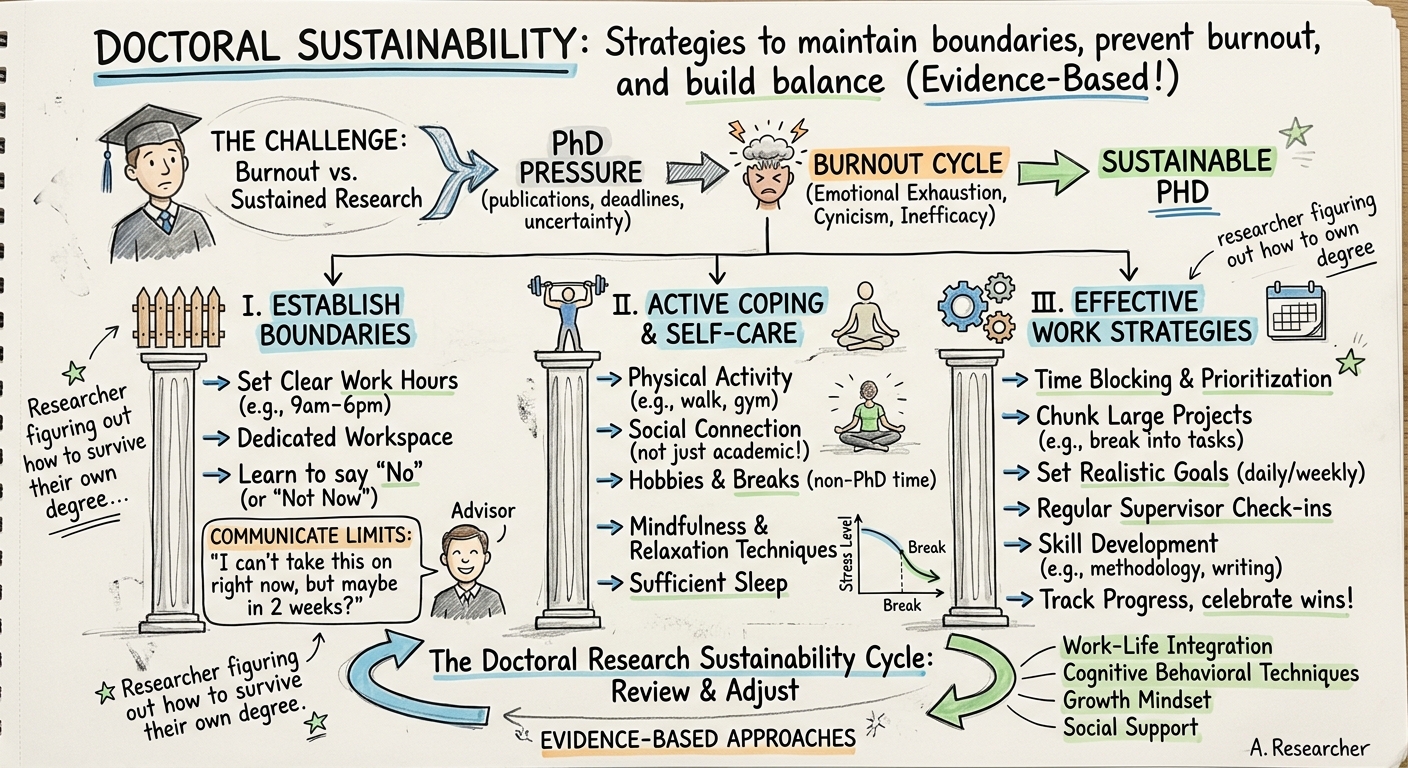
The culture of academia often glorifies overwork. For decades, the implicit expectation within many doctoral programs has been that a PhD requires absolute, uncompromising dedication—often at the expense of personal health, relationships, and well-being. Phrases like "publish or perish" and the normalization of 80-hour workweeks have cultivated an environment where burnout is not just common; it is frequently treated as a rite of passage.
However, a growing body of evidence suggests that chronic overwork yields diminishing returns. Cognitive fatigue impairs critical thinking, stifles creativity, and increases the likelihood of experimental errors. For PhD students, postdocs, and the professors who mentor them, rethinking work-life balance is not merely a matter of wellness—it is a prerequisite for rigorous, high-quality research.
This article provides actionable, evidence-based strategies for navigating the demands of academia while maintaining your well-being. By shifting the paradigm from "balance" to "sustainability," establishing rigid boundaries, and leveraging modern tools, researchers can survive the PhD journey and emerge as healthy, productive scholars.
1. Redefining "Balance" as "Sustainability"
The term "work-life balance" can be inherently misleading. It implies a perfect, daily 50/50 equilibrium between professional obligations and personal life. In the context of a PhD, this static equilibrium is rarely achievable. There will be weeks dominated by grant deadlines, comprehensive exams, or time-sensitive experiments, just as there should be weeks dedicated to rest, holidays, and recovery.
Instead of striving for daily balance, aim for long-term sustainability. A PhD is a marathon that typically spans four to six years. Sprinting the first ten miles will only ensure you collapse before the finish line.
Sustainability means recognizing your physiological and cognitive limits. Human beings are not designed for prolonged periods of high cognitive load without adequate recovery. When you view your research through the lens of sustainability, resting becomes a strategic imperative rather than a guilty indulgence. A well-rested brain is capable of synthesizing complex literature and troubleshooting faulty methodologies far more effectively than an exhausted one.
2. Establishing Non-Negotiable Boundaries
One of the most significant challenges in modern academia is the lack of structural boundaries. Unlike a traditional corporate job, a PhD has no defined "clocking out" time. The work is never truly finished; there is always another paper to read, another data set to analyze, or another manuscript to draft.
Because the university does not impose boundaries, you must engineer them yourself.
Treat the PhD Like a Job
Adopt a professional mindset. Decide on your working hours—whether that is 9:00 AM to 5:00 PM, or 10:00 AM to 6:00 PM—and stick to them. Parkinson’s Law dictates that "work expands so as to fill the time available for its completion." If you give yourself 14 hours a day to complete your research tasks, they will take 14 hours. If you constrain your working hours, you will naturally prioritize high-impact tasks and become more efficient.
Implement Email Blackout Periods
Academic anxiety is frequently fueled by the constant influx of emails. Establish a rule that you do not check your academic email after a certain hour (e.g., 7:00 PM) or on weekends.
If you are a PhD student, communicate these boundaries proactively with your Principal Investigator (PI). A professional way to frame this is: "To ensure I am doing my most focused and productive work during the day, I am implementing a policy of not checking emails after 6:00 PM or on weekends, unless we are facing an immediate grant or publication deadline." Most reasonable advisors will respect this boundary; in fact, many will appreciate the professionalism it demonstrates.
3. Divorcing Your Identity from Your Output
A pervasive psychological trap in academia is enmeshment—the blurring of boundaries between one's self-worth and one's academic output. When your identity is entirely wrapped up in being a "researcher," a rejected manuscript or a failed experiment feels like a personal failure rather than a professional hurdle.
To build resilience against the inevitable rejections of academic life, you must cultivate an identity outside of your department.
- Invest in non-academic hobbies: Engage in activities where you can see tangible progress that has nothing to do with peer review. Whether it is rock climbing, painting, baking, or playing an instrument, having an arena where you can succeed outside of the lab is vital for psychological buffering.
- Maintain diverse social circles: It is easy to socialize exclusively with your lab mates or cohort. While these relationships are valuable for shared empathy, talking only to other academics often leads to "venting sessions" that reinforce academic anxieties. Make a concerted effort to maintain friendships with people outside of academia who can remind you that the world is much larger than your specific sub-field.
4. Strategic Energy Management
Time management is a common topic in academic development, but energy management is arguably more critical. Not all hours in the day are created equal. You may have the time to write your manuscript at 4:00 PM on a Friday, but do you have the cognitive energy?
Deep Work vs. Shallow Work
Cal Newport’s concept of "Deep Work" is highly applicable to the PhD. Deep work refers to professional activities performed in a state of distraction-free concentration that push your cognitive capabilities to their limit. For a researcher, this includes drafting manuscripts, coding, and complex data analysis. Shallow work comprises non-cognitive, logistical, or minor duties performed while distracted—such as answering emails, formatting citations, or filling out reimbursement forms.
- Audit your energy: Identify your biological prime time. Are you sharpest in the morning? Reserve the hours between 8:00 AM and 11:00 AM strictly for deep work. Do not squander your peak cognitive hours on shallow tasks.
- Batch shallow tasks: Dedicate a specific, low-energy block of time (e.g., 3:00 PM to 4:00 PM) to power through emails, scheduling, and administrative paperwork.
5. Leveraging Tools to Reclaim Your Time
One of the most effective ways to improve your work-life balance is to systematically eliminate or accelerate tedious, time-consuming tasks. Modern researchers have access to an unprecedented array of tools designed to streamline the academic workflow.
Streamlining the Peer Review Process
Perhaps no aspect of academia is as emotionally and temporally draining as responding to peer review comments. Receiving a lengthy document of critiques from "Reviewer 2" can ruin a weekend and induce severe imposter syndrome. Crafting a polite, thorough, and point-by-point response document often takes days of agonizing work—time that cuts directly into your personal life or delays other research.
This is where specialized tools like Peereply become invaluable. Peereply is designed specifically to help researchers navigate the peer review response process. By intelligently structuring and drafting evidence-based responses to reviewer comments, tools like Peereply remove the emotional friction from the process. Instead of staring at a blank page, paralyzed by a harsh critique, you are provided with a professional, academic baseline response that you can easily edit and refine.
By automating the structural and tonal aspects of the response letter, you can save dozens of hours per manuscript. Reclaiming those hours means reclaiming your weekends, protecting your cognitive energy, and maintaining your work-life boundaries.
Additional Workflow Optimizations
- Reference Managers: Never format citations manually. Master tools like Zotero, Mendeley, or EndNote early in your PhD.
- Automation Scripts: If you find yourself doing the same data cleaning steps repeatedly, spend a day learning how to write a Python or R script to automate it. The upfront time investment pays massive dividends in the long run.
6. The Role of Advisors and Postdocs: Cultivating a Healthy Culture
Work-life balance is not merely an individual responsibility; it is a systemic issue. Professors, PIs, and senior postdocs play a disproportionate role in setting the cultural tone of a laboratory or research group. If you are in a leadership or mentorship position, you have an ethical obligation to model healthy boundaries.
Lead by Example
If a PI tells their students to "take the weekend off" but routinely sends "urgent" emails at 11:00 PM on a Saturday, the students will listen to the actions, not the words.
- Use the Schedule Send feature: If you prefer to work late at night or on weekends, use your email client's "schedule send" feature so that your team receives the emails at 9:00 AM on Monday. This simple habit dramatically reduces the ambient anxiety of your trainees.
- Normalize vacations: Actively encourage your PhD students to use their allocated vacation days. When they are on vacation, do not contact them. Demonstrate that the lab will survive without them for a week.
- Focus on output, not optics: Judge your researchers by the quality of their data and the clarity of their writing, not by the number of hours they spend sitting visibly at their desks. "Face time" is a toxic metric for academic success.
7. Recognizing and Addressing Burnout
Despite your best efforts, the structural pressures of academia may still push you toward burnout. It is critical to recognize the clinical signs of burnout before it completely derails your PhD.
The World Health Organization categorizes burnout as an occupational phenomenon characterized by three dimensions:
- Energy depletion or exhaustion: Waking up tired despite adequate sleep, or feeling a sense of dread when heading to the lab.
- Increased mental distance or cynicism: Losing sight of why you started the PhD in the first place. Feeling resentful toward your PI, your peers, or the peer review process.
- Reduced professional efficacy: Working longer hours but accomplishing less. Making careless mistakes in the lab or struggling to write a single paragraph.
Actionable Steps for Recovery
If you recognize these symptoms, pushing through is the worst possible strategy.
- Take a hard break: Step away from the lab entirely for at least a few days. Do not read papers; do not check email.
- Communicate with your committee: Have an honest conversation with your PI or thesis committee about your workload. A good advisor wants you to finish the PhD, and they cannot help you if they do not know you are struggling.
- Seek professional support: Utilize your university’s psychological counseling services. Cognitive Behavioral Therapy (CBT) can be highly effective in managing academic anxiety and imposter syndrome.
Conclusion
Achieving work-life balance during a PhD is not about achieving a perfect daily symmetry between work and leisure. It is about establishing robust boundaries, managing your cognitive energy, and utilizing intelligent tools like Peereply to streamline arduous tasks.
Remember that your worth as a human being is not dictated by your h-index, the impact factor of your publications, or the approval of Reviewer 2. By treating your PhD as a job rather than an all-consuming identity, you protect your mental health, ensure the longevity of your career, and ultimately produce higher-quality, more impactful research. Protect your time fiercely—it is the most valuable resource you have.