
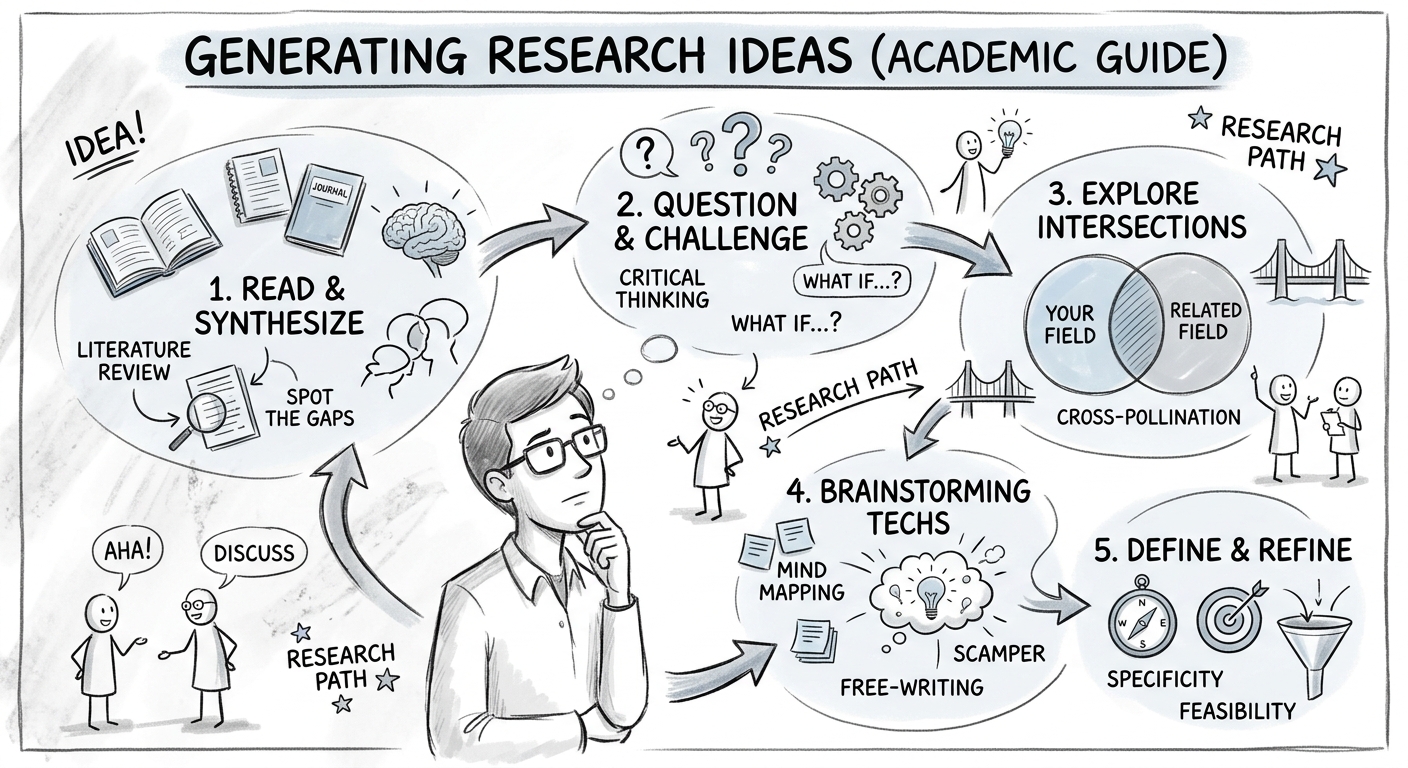
The image of the solitary genius experiencing a "Eureka!" moment in a bathtub is one of the most enduring, yet fundamentally misleading, myths in academia. In reality, generating a high-impact research project idea is rarely a sudden flash of divine inspiration. Rather, it is a systematic, iterative process of observation, critical synthesis, and strategic positioning.
Whether you are a PhD student trying to define your thesis chapters, a postdoctoral researcher seeking a distinct niche to launch an independent laboratory, or a tenured professor drafting your next major grant proposal, the pressure to innovate is constant. The academic currency is novelty, but novelty must be paired with feasibility and significance.
This comprehensive guide deconstructs the process of research ideation. We will explore evidence-based strategies to systematically generate, refine, and stress-test research ideas that are not only intellectually stimulating but also highly publishable and fundable.
1. Dismantling the Myth of the "Eureka" Moment
Before diving into actionable strategies, it is crucial to reframe how we think about ideas. Research ideas exist on a continuum of existing knowledge. As Isaac Newton famously wrote, "If I have seen further it is by standing on the shoulders of Giants."
Innovation in research typically falls into one of three categories:
- Conceptual Innovation: Proposing a new theory or paradigm that challenges existing dogmas.
- Methodological Innovation: Developing a new technique or applying a cutting-edge tool to an existing problem.
- Translational Innovation: Taking findings from one context (e.g., an in vitro model, or a specific demographic) and applying them to a novel context.
Understanding that your idea does not need to reinvent the wheel, but rather add a highly specific, valuable spoke to it, alleviates the paralysis of perfectionism.
2. Strategic Literature Consumption: Reading for Gaps, Not Just Facts
The foundation of any good research idea is a deep understanding of the existing literature. However, passive reading is insufficient. You must read critically and strategically.
The T-Shaped Reading Strategy
Adopt a "T-shaped" approach to your literature review. The horizontal bar represents a broad, superficial understanding of adjacent fields, methodologies, and general scientific trends. The vertical bar represents deep, exhaustive knowledge of your specific sub-niche.
- Broad Reading: Regularly scan high-impact general science journals (e.g., Nature, Science, PNAS) or the flagship journals of disciplines adjacent to yours. Attend departmental seminars outside your immediate focus. The goal here is to spot methodological trends that could be imported into your field.
- Deep Reading: Set up RSS feeds or automated Google Scholar alerts for specific keywords and key authors in your niche. When reading these papers, do not just look at the results. Scrutinize the limitations.
Mining the "Future Directions" Section
Every peer-reviewed paper ends with a discussion of its limitations and suggestions for future research. While some of these are boilerplate, many represent genuine, unanswered questions that the authors lacked the time, funding, or expertise to pursue.
Actionable Advice: Create a living document or a database (using tools like Notion, Obsidian, or Roam Research) specifically dedicated to "Unanswered Questions." Whenever you read a paper and think, "But what about...?" write it down immediately.
3. The Goldmine of Peer Review Feedback
One of the most overlooked sources of new research ideas is the peer review process itself. When you submit a manuscript, peer reviewers act as a highly specialized focus group, stress-testing your work and pointing out its boundaries.
Often, reviewers will suggest additional experiments, new variables to control for, or alternative theoretical frameworks. Frequently, these suggestions are valid but fall outside the scope of your current manuscript.
When you are drafting your rebuttal—perhaps utilizing tools like Peereply to structure professional, evidence-based responses—you will frequently find yourself writing variations of this sentence: “We thank the reviewer for this insightful suggestion. However, exploring the mechanism of X is beyond the scope of the current manuscript and represents an exciting avenue for future research.”
Do not let that "exciting avenue" die in the rebuttal letter.
Actionable Advice: Every time you finish responding to a set of reviewer comments, extract the "out-of-scope" critiques. These are not just defenses for your current paper; they are pre-validated research ideas for your next project. A reviewer has already explicitly stated that this question is interesting and necessary. You have a guaranteed audience for the resulting paper.
4. Frameworks for Systematic Ideation
If you are staring at a blank whiteboard, use these structured frameworks to force creative connections.
Framework A: The Methodological Pivot
Scientific breakthroughs frequently occur when a new technology is applied to an old problem.
- Example: The advent of single-cell RNA sequencing allowed researchers to revisit decades-old questions about cellular heterogeneity in tumors.
- Prompt: What is a traditional, well-studied problem in my field? What is the newest, most disruptive methodology in a neighboring field? What happens if I apply the latter to the former?
Framework B: The Contradiction Resolution
Science progresses through the resolution of conflicting data. Look for meta-analyses or systematic reviews where the results are highly heterogeneous.
- Prompt: Why did Lab A find a positive correlation, while Lab B found a negative one? Is there a hidden moderating variable? Is there a difference in their experimental models? Designing a project specifically to explain a prominent contradiction in the literature is a surefire way to generate high-impact work.
Framework C: The Contextual Translation
Take a well-established phenomenon and test its boundaries by moving it to an extreme or novel context.
- Example (Social Sciences): A psychological bias is well-documented in WEIRD (Western, Educated, Industrialized, Rich, and Democratic) populations. Does it hold true in a non-WEIRD context, or in a digital/virtual reality environment?
- Example (Biomedical): A signaling pathway is heavily studied in liver cancer. What is its baseline function in the healthy aging of the liver, or in a completely different organ system?
5. Building an "Idea Repository" (The Zettelkasten Method)
Ideas are fragile. If you do not capture them, they disappear. Many prolific academics use a variation of the Zettelkasten (slip-box) method, pioneered by sociologist Niklas Luhmann.
The core principle is to take atomic, interconnected notes. When you read a paper, have a conversation at a conference, or listen to a podcast, write down the core insight in your own words. Crucially, link this note to other related notes in your system.
Over time, this repository becomes a web of interconnected thoughts. When you need a research idea, you don't start from scratch; you query your repository. You might find that a note you took on a statistics seminar two years ago perfectly links to a clinical problem you read about yesterday.
6. Stress-Testing and Validating Your Idea
Generating an idea is only the first step. The next, and arguably more difficult, step is killing off the weak ideas. Before you commit months or years to a project, you must rigorously validate it.
The Heilmeier Catechism
George Heilmeier, a former director of DARPA, developed a set of questions to evaluate proposed research programs. Every researcher should be able to answer these questions before starting a project:
- What are you trying to do? Articulate your objectives using absolutely no jargon.
- How is it done today, and what are the limits of current practice? (The literature gap).
- What is new in your approach and why do you think it will be successful? (Your novelty and hypothesis).
- Who cares? If you succeed, what difference will it make? (The impact).
- What are the risks? (Methodological hurdles).
- How much will it cost, and how long will it take? (Feasibility).
- What are the mid-term and final "exams" to check for success? (Milestones).
The "So What?" Test
Pitch your idea to a colleague who is smart but not in your specific sub-field. Explain the hypothesis and the expected outcome. If their reaction is "So what?" you have a problem.
A project might be entirely novel (e.g., "No one has ever measured the effect of playing Mozart on the growth rate of this specific, obscure species of algae"), but if the outcome doesn't change how we understand a broader mechanism, it lacks impact. Novelty without utility is trivia.
The Feasibility vs. Impact Matrix
Plot your potential ideas on a 2x2 grid.
-
Y-Axis: Potential Impact (Low to High)
-
X-Axis: Feasibility/Cost (Hard/Expensive to Easy/Cheap)
-
High Impact, High Feasibility (Quick Wins): Do these immediately. These are often secondary analyses of existing datasets.
-
High Impact, Low Feasibility (Major Grants/Thesis Core): These require significant funding, time, and collaboration. They form the backbone of a multi-year research program.
-
Low Impact, High Feasibility (Incremental): Good for undergraduate projects or quick methodological notes, but don't build your career on them.
-
Low Impact, Low Feasibility (Time Sinks): Discard these immediately.
7. The Role of Collaboration in Ideation
Academic silos are the enemy of innovation. Some of the most groundbreaking research occurs at the intersection of disciplines.
If you are stuck, seek out a conversation with a researcher whose methodology is entirely different from yours. A computational biologist and a field ecologist looking at the same dataset will ask fundamentally different questions.
Furthermore, do not be overly protective of your nascent ideas. The fear of being "scooped" often prevents researchers from discussing their early-stage thoughts. However, the feedback you gain from discussing an idea with trusted mentors and peers usually far outweighs the risk of theft. An idea is just a multiplier; execution is everything.
Conclusion: Ideation is a Habit, Not an Event
Securing a continuous pipeline of research projects is the hallmark of a successful academic career. By shifting your mindset from waiting for inspiration to systematically hunting for gaps, you take control of your research trajectory.
Remember to:
- Read T-shaped: Broad for context, deep for gaps.
- Mine peer review: Turn "out-of-scope" reviewer comments into your next grant proposal.
- Apply frameworks: Cross-pollinate methodologies and target literature contradictions.
- Capture everything: Maintain a rigorous, interconnected idea repository.
- Stress-test ruthlessly: Use the Heilmeier Catechism to ensure your idea is both novel and impactful.
Research ideation is a muscle. The more systematically you exercise it, the more intuitive the process of scientific discovery will become.