
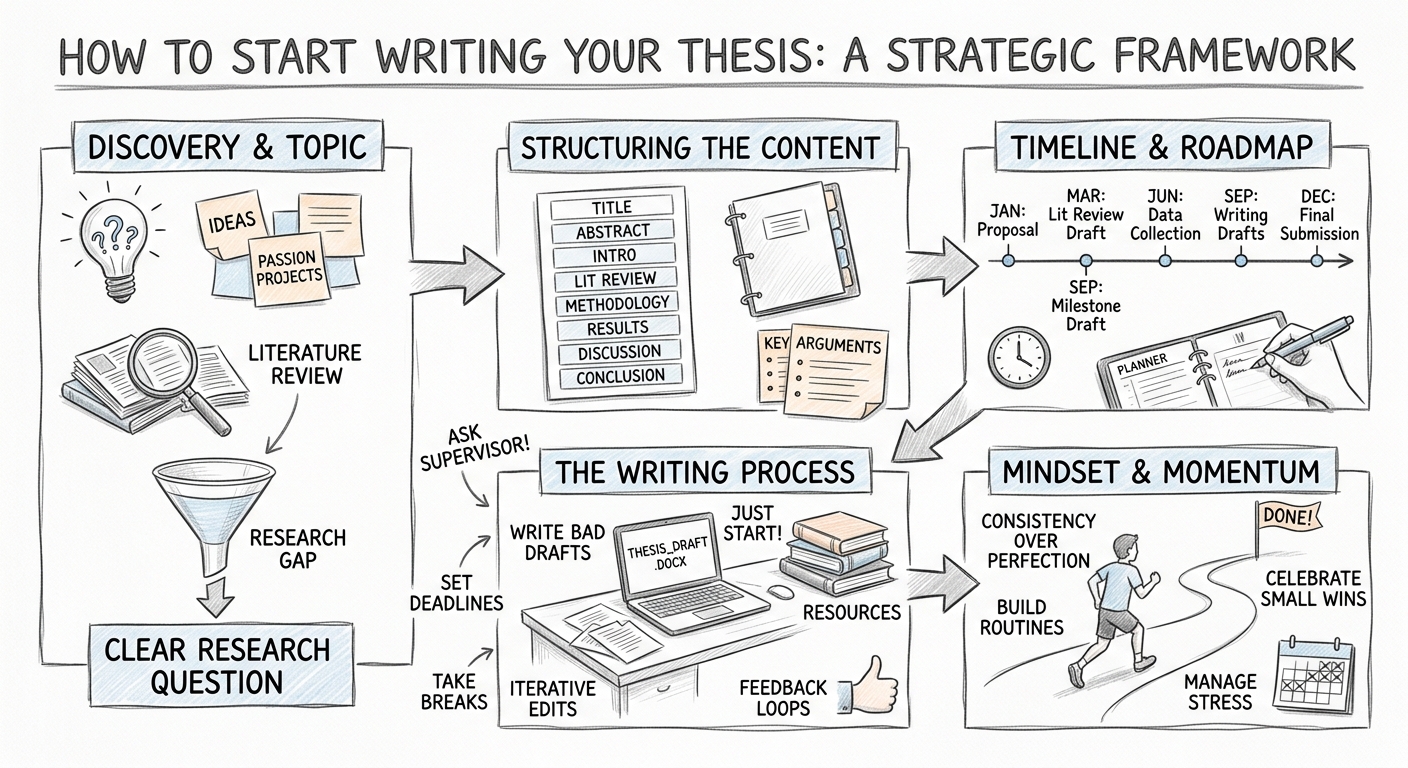
How to Start Writing Your Thesis: A Strategic Framework The transition from conducting research to writing a thesis is notoriously difficult. For months—or years—your primary metric of productivity has been generating data, optimizing protocols, or analyzing literature. Suddenly, you are faced with a blank document and the monumental task of distilling years of work into a cohesive narrative.
The paralysis most researchers feel when starting their thesis does not stem from a lack of knowledge; it stems from a lack of structure. Staring at a blank page waiting for inspiration is a losing strategy. Instead, you need a systematic approach that forces words onto the page.
Here is a practical, evidence-based framework to help you start writing your thesis and build sustainable momentum.
Shift from "Writing" to "Assembling"
The most common mistake researchers make is treating the thesis as a document they must write from scratch. You aren't starting from zero. You already have a wealth of material: grant proposals, conference abstracts, lab meeting slides, published papers, and peer review responses.
Your first step is not writing; it is assembling.
- Audit your existing assets: Gather all your written materials. A published paper can be reformatted into a core data chapter. A comprehensive literature review for a grant can form the backbone of your introduction.
- Leverage peer-reviewed content: If you have already published portions of your research, you have a massive advantage. The methodology and results have already survived the scrutiny of peer review. Use these as your foundational pillars.
Construct a Granular Scaffold
Writer’s block thrives in ambiguity. If your daily to-do list says "Write Chapter 1," you will inevitably procrastinate. The cognitive load of deciding what to write is too high.
Before you write full sentences, build a highly granular scaffold. This is effectively an "ugly outline" that breaks your thesis down into manageable micro-tasks.
- Macro-level: Outline your chapter titles.
- Meso-level: Define the subheadings within each chapter.
- Micro-level: Under each subheading, insert bullet points detailing the specific figures, citations, and core arguments that belong there.
Practical Example: Instead of a vague goal like "Draft Introduction," your scaffold should look like this:
- Subheading: Current Limitations in Diagnostic Assays
- Paragraph 1: Discuss false positive rates (Cite Smith et al., 2022).
- Paragraph 2: Highlight cost barriers in resource-limited settings.
- Paragraph 3: Transition into how our novel assay addresses these gaps.
When you sit down to work, you are simply converting bullet points into sentences.
Tackle the Path of Least Resistance
There is no rule that dictates you must write your thesis chronologically. Starting with the Introduction is often a mistake, as your overarching narrative will likely evolve as you compile your data chapters.
Start with the path of least resistance to build early psychological momentum.
- Begin with the Methods: This is the most straightforward section. You know exactly what you did, the protocols are already in your lab notebook, and it requires minimal narrative flow.
- Move to the Results: Insert your figures and tables into the document first. Then, write the text that describes them. Let the data dictate the structure of the chapter.
- Save the Introduction and Discussion for last: Write these sections only after you know exactly what story your data chapters tell.
Lower the Barrier to Entry
Academic culture often glorifies the "writing binge"—the idea that you need uninterrupted eight-hour blocks to make progress. Evidence suggests otherwise. Binge writing often leads to burnout and long periods of avoidance.
Consistent, low-friction habits are far more effective for long-form academic writing.
- Time-block small sessions: Commit to just 30 to 45 minutes of writing per day. Protect this time fiercely. Turn off email, silence notifications, and focus entirely on your document.
- Set word count micro-goals: Aim for 200 words a day. It sounds insignificantly small, but 200 words a day translates to 1,000 words a week. Consistency compounds.
- Embrace the "Zero-Draft": Your first draft is not supposed to be good; it is supposed to exist. Give yourself permission to write poorly. You can edit a bad page, but you cannot edit a blank one.
Starting your thesis is an exercise in project management as much as it is in writing. Build your scaffold, start with the easiest sections, and rely on daily consistency rather than fleeting inspiration. The words will follow.