
Opening your inbox to find an email that begins with "We regret to inform you..." is a universally deflating experience. Whether you are a first-year PhD student submitting your first manuscript or a tenured professor with hundreds of publications, manuscript rejection stings.
However, in the landscape of academic publishing, rejection is not the exception; it is the default. Top-tier journals routinely boast rejection rates of 80% to 95%. Even specialized, mid-tier journals frequently reject more than half of the submissions they receive.
The difference between a successful researcher and a frustrated one is not the absence of rejection, but the strategy used to navigate it. A rejected paper is rarely a dead end. More often, it is a forced detour that, if navigated correctly, leads to a stronger, more rigorous, and more impactful publication.
This comprehensive guide outlines a professional, evidence-based strategy for handling manuscript rejection. We will cover how to process the decision, decode the editor's and reviewers' feedback, and chart a strategic path toward successful publication.
Step 1: The 48-Hour Rule (Do Nothing)
When you first read a rejection letter, your brain processes it as a threat. The amygdala activates, triggering a defensive emotional response. In this state, reviewers appear vindictive, the editor seems incompetent, and the peer review system feels fundamentally broken.
Actionable Advice: Enforce a strict 48-to-72-hour cooling-off period.
During this time:
- Do not reply to the editor. An emotionally charged email will damage your professional reputation and yield zero positive results.
- Do not immediately submit to another journal. This is a common panic response known as a "blind resubmission," and it is highly detrimental to your paper's chances.
- Do not obsess over the comments. Read the email once to understand the decision, close the document, and step away.
Give your prefrontal cortex time to regain control. You cannot objectively evaluate the scientific merit of a critique while you are emotionally compromised.
Step 2: Decode the Type of Rejection
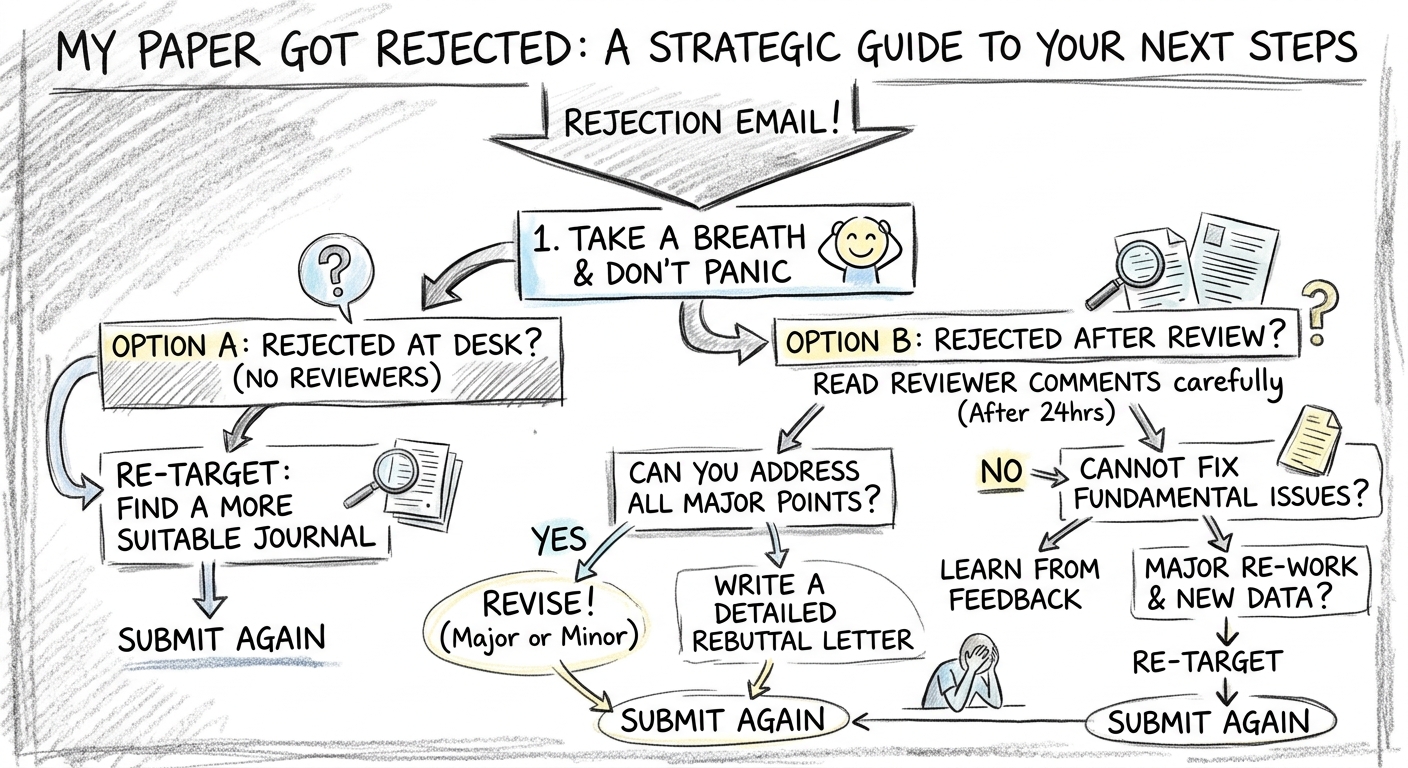
Once the emotional sting has faded, it is time to approach the rejection letter as a scientist. The first step is to categorize the rejection. Broadly speaking, rejections fall into two categories: Desk Rejections and Post-Review Rejections.
1. The Desk Rejection (Rejected without Review)
Desk rejections occur when the handling editor decides the manuscript is not suitable for peer review. This usually happens within a few days to a couple of weeks of submission.
Common reasons for desk rejection include:
- Out of Scope: The paper does not align with the journal's specific aims and readership.
- Lack of Novelty/Impact: The findings are sound but incremental, and the journal prioritizes high-impact, paradigm-shifting research.
- Formatting/Structural Flaws: The manuscript egregiously violates word counts, formatting guidelines, or ethical disclosure requirements.
- Fundamental Methodological Flaws: The editor spots a fatal flaw in the study design that reviewers would immediately flag.
Your Next Move: If the rejection was due to scope or novelty, your paper is likely fine; you simply aimed at the wrong target. Recalibrate your journal selection and submit elsewhere. If the editor pointed out methodological or structural flaws, you must address these before submitting to a new venue.
2. The Post-Review Rejection
This rejection hurts more because you waited months for it. However, it is also vastly more valuable because it comes with peer review reports.
Read the editor's decision letter carefully. Editors often provide a summary of why they chose to reject the paper based on the reviewer comments.
- Did all reviewers recommend rejection?
- Did one reviewer champion the paper while another tore it apart?
- Did the editor specifically state that the journal does not allow major revisions, but hint that the paper has merit?
The editor's letter is your roadmap to understanding which reviewer critiques were considered the most damning.
Step 3: Perform a Triage on Reviewer Comments
Reviewers are not infallible, but they are representative of your target audience. If a reviewer misunderstood your methodology, it is highly likely that future readers will misunderstand it, too. Therefore, the blame rests on the clarity of the manuscript, not the intelligence of the reviewer.
To process the feedback objectively, perform a "Comment Triage." Extract every critique from the reviewer reports and categorize them into a spreadsheet.
Categorize each comment into one of four buckets:
Bucket A: Fatal Flaws (Valid)
These are fundamental issues with your study design, sample size, or core assumptions.
- Example: "The authors used a linear regression model, but the data clearly violates the assumption of homoscedasticity."
- Action: You cannot ignore this. You must re-analyze your data or fundamentally alter the scope of your claims before submitting anywhere else.
Bucket B: Fixable Methodological/Analytical Issues (Valid)
These require work but do not destroy the paper.
- Example: "The authors should include a control experiment to rule out variable X."
- Action: Perform the extra experiment, run the additional statistical test, or pull the extra dataset.
Bucket C: Clarity and Presentation (Valid)
These are issues where the reviewer was confused by your writing.
- Example: "The transition between the introduction and the specific aims is abrupt, and the rationale for using the XYZ assay is unclear."
- Action: Rewrite the offending sections. Clarity is the easiest thing to fix.
Bucket D: Disagreements and Misunderstandings (Subjective/Invalid)
These occur when the reviewer has a philosophical disagreement with your approach, asks for experiments completely outside the scope of the paper, or demonstrably misread the text.
- Example: "The authors should have used an entirely different theoretical framework (one that the reviewer happens to have invented)."
- Action: You do not necessarily need to change your entire paper to appease an unreasonable request, but you do need to add a few sentences explicitly defending your chosen framework to preempt similar complaints from future reviewers.
Step 4: The Danger of the "Blind Resubmission"
A common mistake researchers make is the "blind resubmission"—taking a rejected manuscript, changing the formatting to match a new journal, and submitting it without making any changes based on the previous reviewers' comments.
Do not do this.
The academic world is smaller than you think. Editors at different journals frequently use the same databases to find reviewers. It is incredibly common for a manuscript submitted to Journal B to be sent to the exact same reviewer who rejected it at Journal A.
If "Reviewer 2" receives your manuscript again and sees that you ignored all of their previous critiques, they will be instantly biased against you. They will likely recommend a rapid rejection, and they may even inform the new editor that you are "journal shopping" without improving the science.
Always revise your manuscript based on valid critiques before submitting it to a new journal.
Step 5: Choose Your Next Path
With your triage complete and your revisions planned, you have three potential paths forward.
Path 1: The Appeal (Use with Extreme Caution)
Appealing a rejection is rarely successful (success rates are typically below 10%). You should only appeal a rejection if you can prove, with objective evidence, that the reviewers made a severe factual error that directly led to the rejection.
- Do NOT appeal because: You think the reviewers were "mean," you disagree with their subjective assessment of novelty, or you feel the editor weighed Reviewer 2's comments too heavily.
- DO appeal if: The reviewer stated, "The authors failed to include a control group," but you actually did include a control group, and it is clearly detailed on page 8, Figure 2.
If you appeal, write a brief, highly professional email to the editor pointing out the specific factual error and asking if they would be willing to reconsider the manuscript. Accept their final decision gracefully.
Path 2: Submit to a New Journal (The Most Common Route)
If you are moving to a new journal, you need to employ a "cascading" strategy.
- Vertical Cascading: If your paper was rejected by a top-tier, broad-interest journal (e.g., Nature, Science, Cell) due to a lack of broad impact, cascade down to a highly respected, discipline-specific journal.
- Horizontal Cascading: If your paper was rejected because it was out of scope, look for a journal with a similar Impact Factor but a slightly different editorial focus.
When choosing your next journal, look at your own reference list. Where are the papers you cited published? Those journals are likely a good fit for your work.
Path 3: Shelve and Restructure
Sometimes, the reviewers are right. If the feedback reveals that your sample size is fundamentally inadequate, or your core hypothesis has already been disproven by a paper you missed, it may be time to shelve the manuscript.
Shelving a paper is not a failure; it is an act of scientific integrity. You can salvage the literature review for a future grant proposal, or use the preliminary data to justify a larger, better-designed study.
Step 6: Revise and Draft an "Internal Rebuttal"
Before you submit to your new target journal, you must revise the manuscript.
One of the most effective strategies for ensuring your revisions are robust is to write an Internal Rebuttal. Treat the process exactly as you would if you had received a "Revise and Resubmit" (R&R) decision.
Create a document where you list every major critique from the rejection, and write a detailed response explaining exactly how you have altered the manuscript to address it.
Why do this if the new journal won't see the rebuttal?
- Accountability: It forces you to actually fix the problems rather than just glossing over them.
- Preempting Future Reviewers: If Reviewer A had a problem with your statistical analysis, Reviewer B at the next journal will likely have the same problem. Your internal rebuttal ensures the manuscript is now bulletproof against that specific critique.
- Cover Letter Material: You can use elements of this internal rebuttal in your cover letter to the new journal. (e.g., "In preparing this manuscript, we have rigorously validated our model against [Critique X], ensuring robust results...")
How Peereply Can Assist in the Rebound
Drafting responses to reviewer comments—even internal ones—is cognitively taxing. It is difficult to maintain a polite, objective, academic tone when you feel your work has been unfairly criticized.
This is where tools like Peereply become invaluable. While Peereply is designed to help researchers craft responses for R&R decisions, it is equally powerful for managing the revision process after a rejection.
You can input the harsh or confusing reviewer comments from your rejection into Peereply. The tool will help you:
- De-escalate the Tone: Translate your frustrated internal thoughts into objective, professional academic language.
- Structure the Defense: Help you formulate a clear, evidence-based rationale for why you made specific changes (or why you chose to maintain your original approach, backed by literature).
- Identify Gaps: By forcing you to clearly articulate your response, the tool helps highlight areas where your manuscript's logic may still be weak, guiding your rewriting process.
Using an AI-assisted tool to draft your internal rebuttal saves hours of agonizing over phrasing, allowing you to focus your energy on actually improving the science and data within the manuscript.
Conclusion: Rejection as a Stepping Stone
Every prolific academic has a folder on their computer filled with rejection letters. The sting of rejection never entirely goes away, but your ability to process it and pivot strategically will improve with time.
Remember that peer review, for all its flaws, is designed to stress-test your science. A rejection is simply a stress test that revealed a fracture. By taking a cooling-off period, objectively decoding the feedback, avoiding the trap of the blind resubmission, and rigorously revising your manuscript, you transform a rejection from a roadblock into a stepping stone.
Your paper is not dead. It is just in draft mode. Revise, strategize, and submit again.