For decades, the traditional trajectory for a PhD graduate was strictly linear: complete your dissertation, secure a postdoctoral fellowship, land a tenure-track faculty position, and eventually earn tenure. In this historical context, moving into the private sector was often quietly—and unfairly—stigmatized as an "alternative" career path or even a failure to succeed in the academic gauntlet.
Today, that paradigm has completely shifted. With the number of newly minted PhDs vastly outpacing the availability of tenure-track positions, and with private sector research and development (R&D) budgets dwarfing those of federal grant agencies, the choice between academia and industry is no longer a matter of default. It is a strategic career decision.
Whether you are a third-year PhD student feeling the first pangs of burnout, a postdoc weighing your next move, or even a junior faculty member reconsidering your long-term goals, deciding between academia and industry requires a clear-eyed assessment of your values, working style, and financial priorities.
This guide breaks down the core differences between the two paths to help you make an informed, evidence-based decision.
Work Culture and Pacing: The Marathon vs. The Sprint
The most immediate shock for researchers transitioning between these two worlds is the difference in pacing and daily work culture.
In academia, the timeline is fundamentally a marathon. Projects are measured in years. The grant application cycle takes months, data collection can take years, and the peer review process—as anyone waiting on a response from Reviewer 2 knows—can drag on indefinitely. You are rewarded for deep, exhaustive exploration of a highly specific niche. The culture is largely autonomous; as a Principal Investigator (PI) or an independent postdoc, you manage your own time, set your own deadlines, and operate as a sole proprietor of your intellectual franchise.
Industry operates on a series of sprints. Timelines are dictated by quarterly earnings, product launch dates, and market demands. A project that an academic might want to spend three years perfecting will often be allocated three months in industry to develop a "minimum viable product." The phrase "perfect is the enemy of good" is a foundational philosophy in the private sector.
Furthermore, industry is hyper-collaborative. While academics collaborate, industry teams are deeply cross-functional. A data scientist in industry will not just work with other data scientists; they will work daily with product managers, software engineers, marketing teams, and legal departments. Success is measured not by individual brilliance, but by team alignment and the ability to execute on a shared corporate objective.
Research Autonomy: Curiosity-Driven vs. Market-Driven
The primary draw of academia is intellectual freedom. In theory, an academic can research whatever they find fascinating. In practice, this freedom is constrained by funding agencies. You can research whatever you want, provided you can convince the NIH, NSF, or a private foundation to pay for it. Even so, academia remains the premier environment for fundamental, curiosity-driven research—asking "why" without immediately needing to justify the "how much will this sell for."
In industry, research is strictly market-driven. You are paid to solve specific problems that align with the company's strategic goals. If the company pivots its strategy, your project may be abruptly canceled, regardless of how scientifically interesting it is or how close you are to a breakthrough.
However, this lack of absolute autonomy comes with a significant tradeoff: resources. In academia, you may spend 40% of your time writing grants to secure a $200,000 budget. In industry, if your project aligns with a multi-billion-dollar corporate objective, you may be handed a $2 million budget and a team of five engineers without ever writing a grant proposal. Industry researchers often find immense satisfaction in seeing their work rapidly translated into tangible products that impact millions of users, a scale of immediate real-world application that academia rarely offers.
Compensation, Progression, and Job Security
It is an open secret that academia relies on the highly subsidized labor of graduate students and postdocs. The financial disparity between academia and industry is stark, and it is a perfectly valid reason to choose the private sector.
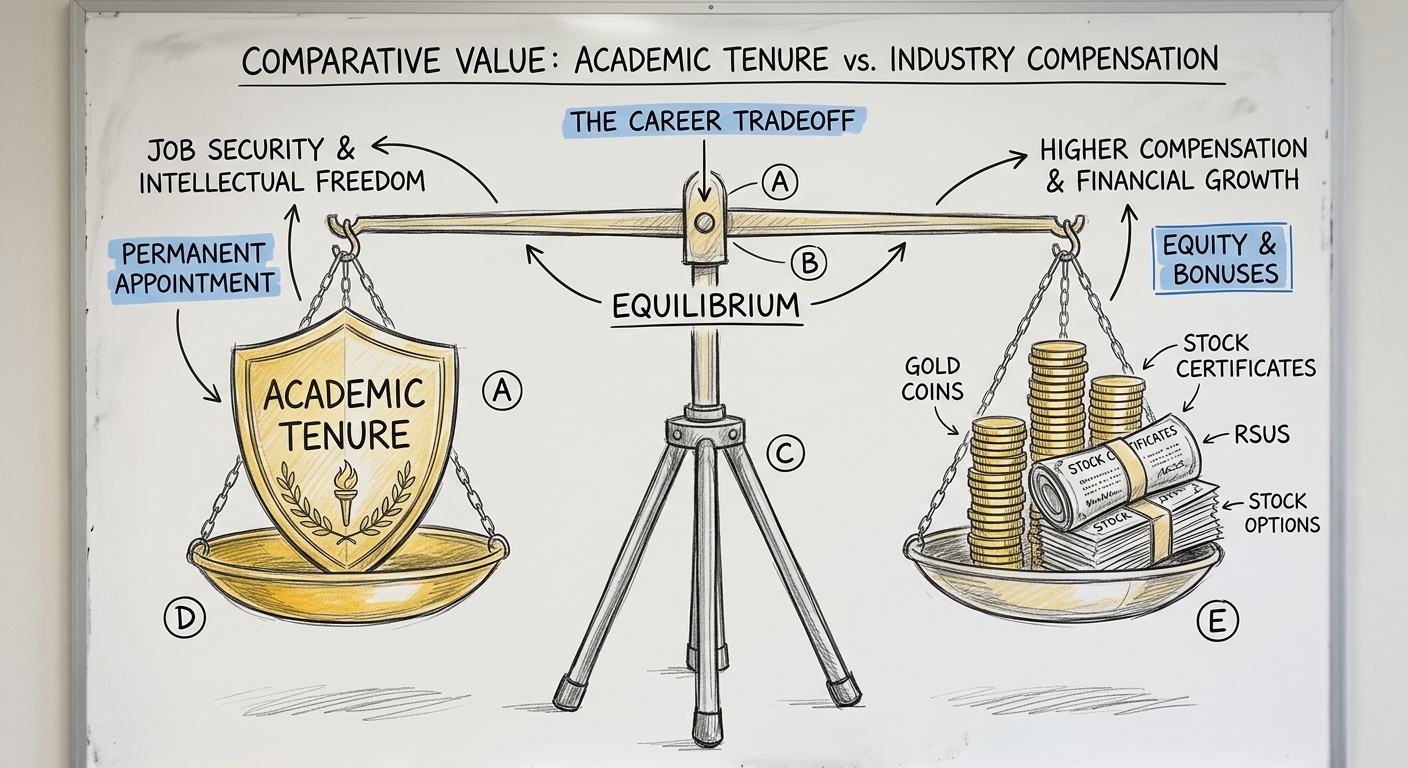
Compensation In STEM fields, a starting industry salary for a PhD can easily be double or triple that of a postdoctoral fellowship. Beyond the base salary, industry compensation packages typically include annual performance bonuses, sign-on bonuses, and equity (stock options or restricted stock units), which can lead to significant wealth accumulation over time. Academics, conversely, generally rely on a fixed 9-month or 11-month salary, often needing to secure their own summer funding through grants.
Career Progression The academic career ladder is rigid and bottlenecked: Assistant Professor, Associate Professor, Full Professor. The criteria for advancement are heavily weighted toward publication record, grant acquisition, and, to a lesser extent, teaching and service.
Industry offers a dual-track progression model at most major companies: the Individual Contributor (IC) track and the Management track. If you love bench work or coding and hate managing people, you can advance to a "Principal Scientist" or "Staff Engineer" level, earning a director-level salary while remaining focused on technical work. If you prefer strategy and leadership, you can transition into management.
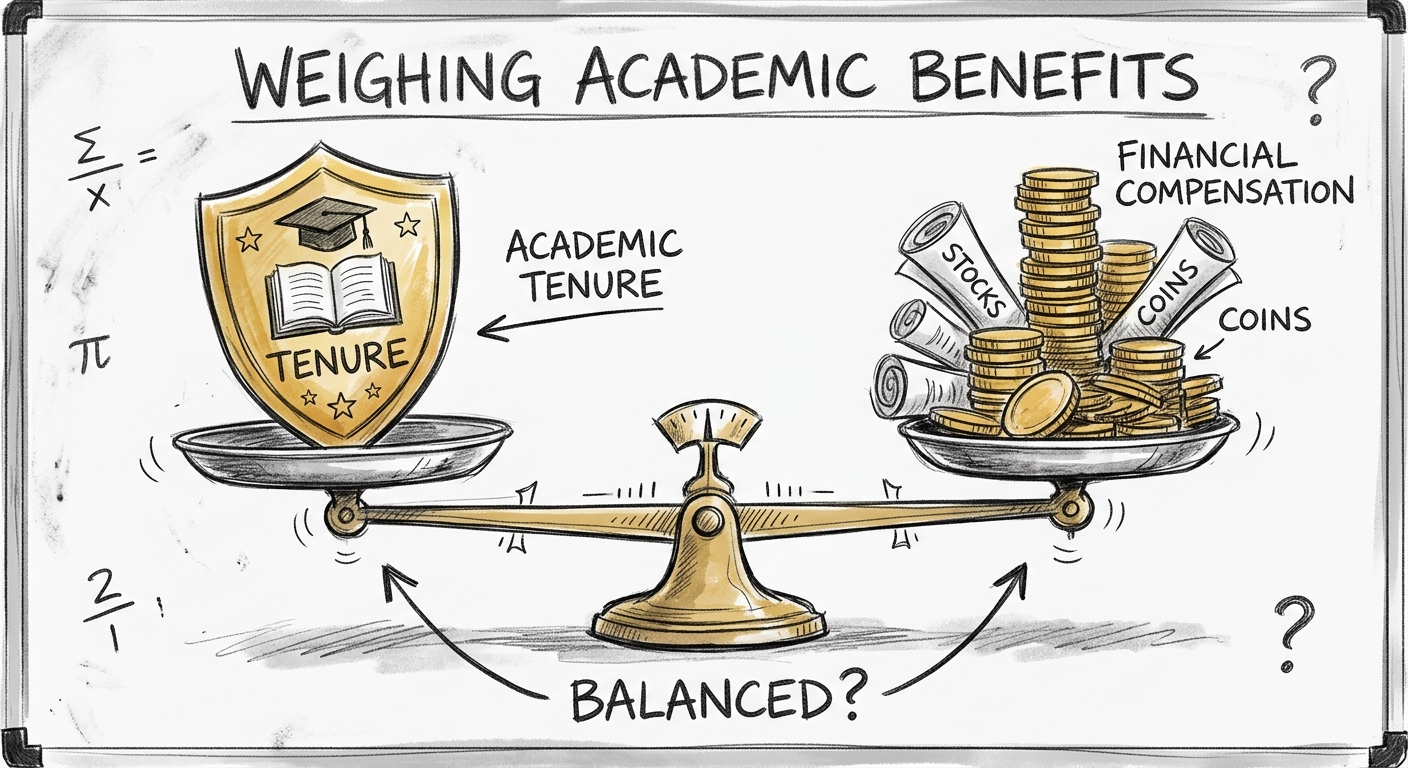
Job Security This is the one area where academia holds a trump card, but only for a select few. Academic tenure provides a level of job security that simply does not exist in the private sector. Once tenured, you are largely protected from economic downturns.
Industry is subject to market volatility. Layoffs, restructurings, and mergers are common. However, highly skilled PhDs in industry often view their security not as being tied to a single employer, but to their employability in the broader market. If you are laid off from a tech or biotech firm, your highly specialized skills usually ensure you will be scooped up by a competitor relatively quickly.
The Hidden Value of Academic Skills in Industry
A common fear among transitioning academics is that they lack "industry skills." This is a misconception. PhDs and postdocs possess incredibly valuable, transferable skills; they simply need to learn how to translate academic terminology into corporate language.
- Handling Rigorous Feedback: In academia, you are trained to survive brutal peer review. When you submit a manuscript, you must systematically, politely, and comprehensively respond to highly critical feedback from experts. (Tools like Peereply exist precisely to help manage this complex, high-stakes communication). In industry, this translates directly to stakeholder management. The ability to defend your methodology to a skeptical Vice President, incorporate cross-departmental feedback without taking it personally, and revise a project strategy under pressure is a superpower that most entry-level corporate employees lack.
- Project Management: A PhD is essentially a 5-year project management certification. You have managed budgets, supervised junior researchers (undergrads), navigated regulatory compliance (IRB/IACUC), and delivered a final product (your dissertation).
- Dealing with Ambiguity: Industry desperately needs people who can look at a vague, unstructured problem, figure out what data is needed to solve it, and execute a plan. Academics do this every day when they design novel experiments.
A Framework for Making Your Decision
If you are standing at the crossroads, do not make a decision based on what your PI wants or what your cohort is doing. Ask yourself the following diagnostic questions:
- What is my relationship with publishing? If the idea of never publishing another peer-reviewed paper breaks your heart, academia (or a highly specialized industry R&D lab) is likely your home. If you view writing papers and responding to reviewers as a tedious hurdle rather than a calling, industry will feel like a massive relief.
- How much do I value being the "boss" of my ideas? If you need to have final say over your research direction and want your name at the top of the marquee, the academic PI route is necessary. If you are happy to be a critical gear in a much larger, well-funded machine, industry is a great fit.
- What are my financial and geographic boundaries? The academic job market often requires you to move wherever the job is, sometimes to rural college towns, and accept lower pay. Industry hubs (like Silicon Valley for tech, or Boston/San Francisco for biotech) offer higher pay and the ability to change companies without having to uproot your family.
- Do I prefer deep dives or broad impact? Do you want to spend ten years understanding one specific protein pathway perfectly? Or do you want to spend two years developing a drug that uses that pathway, even if you never fully map the underlying mechanism?
The Porous Boundary
Finally, remember that the boundary between academia and industry is more porous than ever. It is increasingly common for industry scientists to hold adjunct professorships, or for tenured professors to take sabbaticals at tech companies or launch their own startups.
Choosing industry over academia is not closing a door forever; it is simply walking through a different one. The rigorous analytical thinking, resilience, and communication skills you honed during your academic training will serve as the foundation for your success, regardless of which path you choose to walk.