
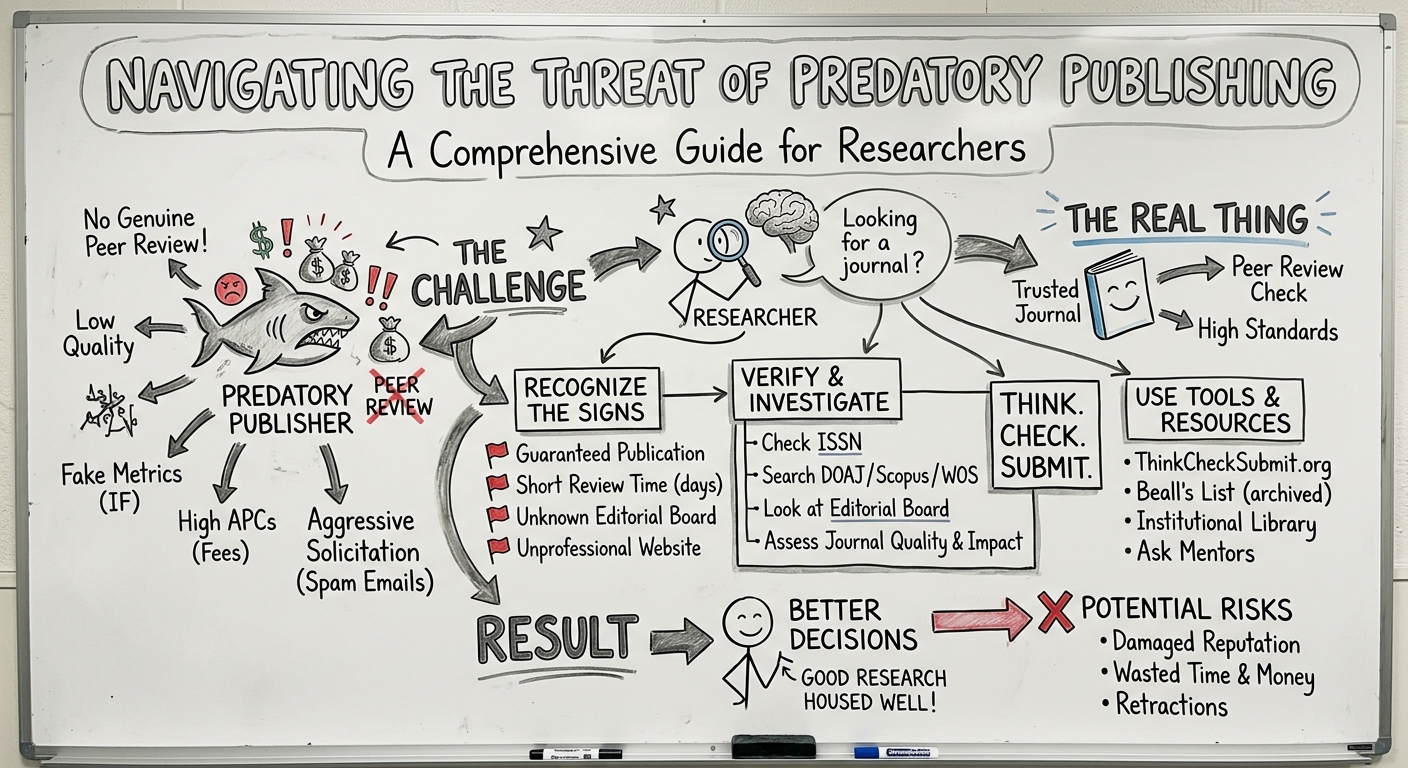
The transition toward Open Access (OA) publishing has fundamentally democratized the dissemination of scientific knowledge. However, this paradigm shift has also birthed one of the most pervasive threats to modern academic integrity: predatory publishing. Exploiting the "publish or perish" culture and the author-pays Article Processing Charge (APC) model, predatory publishers prioritize financial gain over scholarly rigor.
For PhD students, postdoctoral researchers, and tenured professors alike, falling victim to a predatory journal is more than just a financial loss. It can irrevocably damage your academic reputation, compromise the discoverability of your research, and invalidate months or years of hard work.
This comprehensive guide explores the mechanics of predatory publishing, the evolving sophistication of their tactics, and actionable frameworks to ensure your research is submitted to legitimate, high-quality journals.
The Rise and Evolution of Predatory Publishing
The term "predatory publisher" was coined in 2010 by Jeffrey Beall, a librarian at the University of Colorado Denver, who maintained "Beall's List"—a widely used directory of potentially, possibly, or probably predatory scholarly open-access publishers. While Beall's List was taken offline in 2017, the problem has only proliferated.
Initially, predatory journals were easy to spot. They featured poorly designed websites, blatant spelling errors, and highly generic titles (e.g., The International Journal of Science and Research). Today, the landscape is vastly more complex. Predatory publishers have professionalized their operations, creating slick websites, inventing sophisticated fake metrics, and even "hijacking" legitimate journals.
Understanding their current tactics is the first line of defense in protecting your scholarly output.
The Anatomy of a Predatory Journal: Key Warning Signs
Predatory journals operate by mimicking the infrastructure of legitimate academic publishing while stripping away the rigorous quality control. Here are the primary red flags to watch for:
1. Aggressive and Flattering Email Solicitations
Legitimate journals rarely, if ever, send unsolicited emails praising your past work and begging for submissions. Predatory journals utilize automated scraping tools to harvest email addresses from university directories and recent conference proceedings.
Red flags in email solicitations:
- Overly flattering language (e.g., "We were deeply moved by your esteemed research on...").
- Invitations to submit research outside the journal's stated scope (e.g., a nursing journal asking for a paper on quantum physics).
- Urgent deadlines for upcoming "special issues" that are only days away.
- Emails originating from non-institutional addresses (e.g., @gmail.com or @yahoo.com) despite claiming to represent an international organization.
2. The Illusion of Peer Review
Rigorous peer review is the bedrock of scientific publishing. It is a time-consuming process that requires identifying appropriate experts, securing their agreement, and allowing them time to critically evaluate the manuscript.
Predatory journals often promise exceptionally rapid peer review—sometimes guaranteeing acceptance within 48 to 72 hours. In reality, no actual peer review takes place. The manuscript is simply subjected to a cursory formatting check before an acceptance letter (and an invoice) is generated.
Note: If you receive a peer review report that only contains vague praise ("This is a good paper, accept as is") and requires no substantive revisions or structured rebuttal, you are likely dealing with a predatory entity. Genuine peer review requires you to defend your methodology, clarify your findings, and draft comprehensive response letters—a complex process that tools like Peereply are specifically designed to help researchers navigate.
3. Opaque Article Processing Charges (APCs)
Legitimate OA journals are transparent about their APCs. The fees are clearly stated on the journal's website, and they are only billed after a manuscript has successfully passed peer review and been accepted.
Predatory journals often hide their fees until the paper has been "accepted." Alternatively, they may advertise unusually low APCs (e.g., $50–$150) to lure early-career researchers from developing nations, only to add hidden "formatting" or "handling" fees later.
4. Fictitious Editorial Boards
To project an aura of legitimacy, predatory publishers often list prominent academics on their editorial boards. In many cases, these scholars have not given their permission to be listed and are entirely unaware of their association with the journal.
In other instances, the editorial board is composed of fabricated personas, or researchers who possess no actual expertise in the journal's purported field.
5. Deceptive Metrics and Indexing
Predatory journals know that researchers are evaluated based on the Impact Factor of the journals they publish in. Because they cannot achieve a legitimate Journal Impact Factor (JIF) from Clarivate Analytics, they invent fake metrics.
Fake metrics to watch out for:
- Universal Impact Factor (UIF)
- Global Impact Factor (GIF)
- CiteFactor
- Scientific Journal Impact Factor (SJIF)
Furthermore, they will often claim to be indexed in major databases like Scopus, Web of Science, or PubMed, when in reality, they are only indexed in non-evaluative search engines like Google Scholar or ResearchGate.
Hijacked Journals: A Sophisticated Mutation
One of the most alarming trends in predatory publishing is the phenomenon of "hijacked journals." In this scenario, malicious actors identify a legitimate, often print-only or regionally focused academic journal that lacks a strong online presence.
The hijackers register a domain name very similar to the legitimate journal, clone its branding, and set up a fraudulent website. They then aggressively solicit submissions and collect APCs. Researchers believe they are submitting to a respected, indexed journal, only to find their work published on a counterfeit site.
How to spot a hijacked journal:
- Cross-reference the journal's URL with the official link provided in the Web of Science Master Journal List or the Scopus database.
- Check the archives. Hijacked journals often have incomplete archives or suddenly show a massive spike in published articles in recent months.
- Look for discrepancies in the APC. If a traditionally subscription-based journal suddenly demands an APC via a sketchy payment portal, investigate further.
The Real Cost of Predatory Publishing
The consequences of publishing in a predatory journal extend far beyond the lost APC.
Reputational Damage
Hiring committees, tenure boards, and grant funding agencies are increasingly vigilant about predatory publishing. Having predatory journals on your CV can be viewed as a lack of academic judgment or, worse, an attempt to artificially inflate your publication record.
Loss of Research
Predatory publishers rarely invest in long-term digital preservation (such as CLOCKSS or Portico). If the publisher's website goes offline—which happens frequently when they rebrand to avoid scrutiny—your research disappears from the internet entirely.
Inability to Republish
Because the predatory journal technically "published" your manuscript, submitting it to a legitimate journal afterward constitutes self-plagiarism or duplicate publication. Your research essentially becomes trapped in a dead-end venue.
A Step-by-Step Framework for Evaluating Journals
To protect your research, you must adopt a proactive, skeptical approach to journal selection. The internationally recognized Think. Check. Submit. campaign provides an excellent baseline.
Before submitting any manuscript, run the journal through this rigorous checklist:
1. Verify Indexing in Trusted Databases
Do not take the journal's website at its word. If the journal claims to be indexed in Scopus, go to the Scopus database and search for the journal manually. Ensure the coverage years are current. Do the same for the Web of Science Master Journal List and PubMed/MEDLINE.
2. Check the Directory of Open Access Journals (DOAJ)
The DOAJ is a community-curated online directory that indexes and provides access to high-quality, open-access, peer-reviewed journals. To be listed in the DOAJ, a journal must pass a strict evaluation process. If an OA journal is not in the DOAJ, treat it with extreme caution.
3. Look for COPE and OASPA Membership
Legitimate publishers are typically members of the Committee on Publication Ethics (COPE) and the Open Access Scholarly Publishers Association (OASPA). Both organizations require members to adhere to strict ethical guidelines. Verify the journal's membership directly on the COPE and OASPA websites.
4. Audit the Editorial Board
Select two or three members of the editorial board and look up their institutional profiles. Do they list the journal on their official university CV? If you are still unsure, send a polite email to a board member asking about their experience with the journal. If they bounce back or the academic denies involvement, walk away.
5. Evaluate the Quality of Published Articles
Read three recent articles published in the journal. Are they scientifically sound? Is the English of an acceptable academic standard? Do the articles fit the stated scope of the journal? If the articles read like unedited first drafts, the peer review process is compromised.
The Role of Genuine Peer Review
It is crucial to emphasize the difference between the predatory "rubber stamp" and genuine peer review. Legitimate academic publishing is inherently critical. When you submit to a reputable journal, you should expect a rigorous evaluation of your methodology, data analysis, and conclusions.
Receiving a "Revise and Resubmit" (R&R) decision accompanied by pages of critical reviewer comments is not a failure; it is a hallmark of legitimate scholarly communication. Responding to these comments requires patience, precision, and a structured rebuttal.
This is precisely where tools like Peereply add immense value to the research workflow. Peereply helps researchers synthesize complex reviewer feedback and draft professional, evidence-based responses, ensuring that the rigorous standards of legitimate peer review are met efficiently. Predatory journals bypass this entire ecosystem, robbing authors of the opportunity to improve their work through constructive critique.
What to Do If You Fall Victim
Even vigilant researchers can occasionally be deceived by highly sophisticated predatory publishers. If you realize you have submitted your manuscript to a predatory journal, take immediate action:
- Do Not Pay the APC: If you discover the journal is predatory after acceptance but before payment, refuse to pay the invoice. Predatory publishers may send threatening emails citing "legal action," but these are virtually always empty threats. They operate across international borders and will not sue you over a few hundred dollars.
- Send a Formal Withdrawal Letter: Draft a clear, unequivocal email stating that you are withdrawing your manuscript from consideration and that you do not grant them permission to publish it. Keep a record of this correspondence.
- Ignore Threats: The publisher may demand a "withdrawal fee." Do not pay it. Legitimate journals do not charge withdrawal fees.
- Do Not Submit Elsewhere Until Resolved: If the predatory journal publishes your paper against your will (which sometimes happens), you enter a difficult grey area. You must consult with your institution's research integrity office before attempting to submit the manuscript to a legitimate journal, as you will need to explain the situation to the new editor to avoid accusations of duplicate publishing.
Conclusion
Predatory publishing is a parasitic enterprise that drains resources from the academic community and pollutes the scientific record. However, by understanding their tactics and applying rigorous vetting frameworks, researchers can easily sidestep these traps.
Protecting your research requires the same level of diligence that you apply to your methodology and data analysis. Always verify indexing, demand transparency regarding fees, and remember that genuine peer review—while demanding and sometimes frustrating—is the ultimate safeguard of academic excellence. Embrace the rigorous feedback of legitimate journals, utilize tools to manage your revisions effectively, and ensure your hard-earned research finds the respected home it deserves.