
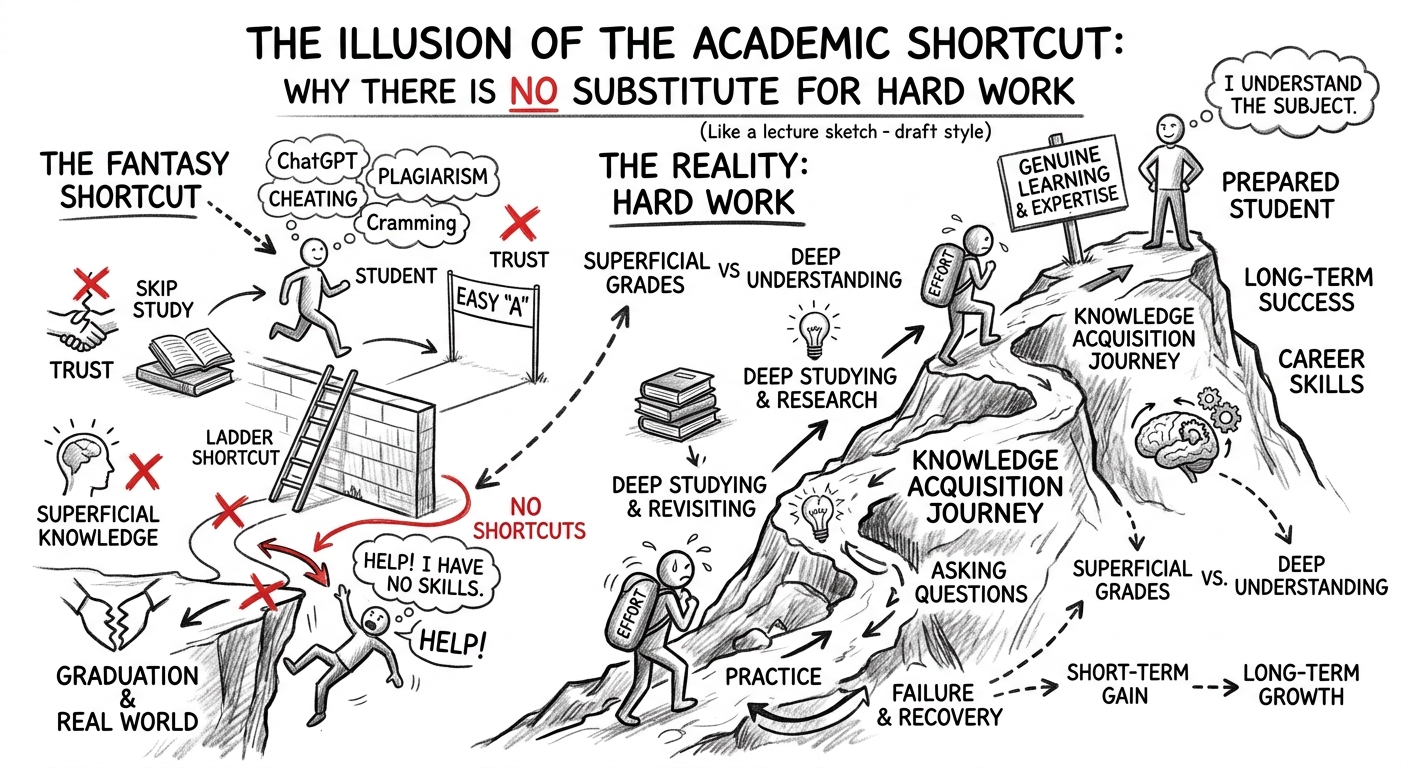

The Productivity Trap in Modern Academia
We live in the era of the "hack." Across social media platforms, productivity gurus and academic influencers promise shortcuts to success: how to write a manuscript in a weekend, how to automate your literature review with AI, or how to effortlessly secure a high-impact publication.
For overworked PhD students, postdocs juggling multiple projects, and tenure-track professors drowning in administrative duties, these promises are intensely seductive. Academia is an environment defined by high pressure and scarce resources. Who wouldn't want a shortcut?
However, there is a fundamental truth that often gets buried beneath the hype of new software and productivity frameworks: There is no way around hard, rigorous work.
The generation of novel human knowledge is not a hackable process. It is inherently difficult, messy, and cognitively demanding. While modern tools can remove the friction from our workflows, they cannot replace the intellectual labor required to design a robust experiment, synthesize contradictory literature, or construct a watertight response to a critical peer reviewer.
In this guide, we will explore the difference between "busy work" and "hard work," examine why the peer review process remains the ultimate crucible for academic rigor, and discuss how to channel your effort effectively without burning out.
Defining "Hard Work" in the Modern Research Context
To understand why hard work is unavoidable, we first need to define what it actually is. In academia, it is easy to confuse exhaustion with productive labor.
Responding to 100 emails, formatting citations to match a journal's obscure guidelines, and tweaking the colors on a PowerPoint slide for three hours will make you tired. But this is not the "hard work" of academia; it is shallow work, or what we might call administrative friction.
True academic hard work—what Cal Newport famously termed "Deep Work"—involves pushing your cognitive capabilities to their limit to create new value or improve your skills. In the context of research, this looks like:
- Conceptualization: Staring at a whiteboard for hours trying to figure out why your control group behaved unexpectedly.
- Methodological Rigor: Spending an extra month validating an assay or refining a computational model to ensure your results are not artifacts.
- Synthesis: Reading fifty dense papers not just to cite them, but to genuinely understand the epistemological gaps in your field.
- Scientific Argumentation: Drafting and re-drafting a manuscript or a peer review rebuttal until the logic is unassailable.
This type of work is uncomfortable. It induces cognitive strain. It frequently leads to dead ends and requires you to start over. But it is precisely this discomfort that produces high-quality science. If a research problem is easy to solve, it has likely already been solved.
The Peer Review Crucible: Where Shortcuts Go to Die
Nowhere is the necessity of hard work more apparent than in the peer review process.
When you submit a manuscript, you are presenting your hard work to the scientific community. When the decision letter arrives with a "Major Revision" and three pages of dense, critical comments from Reviewer 2, the natural instinct is to look for the easiest way out.
Can we just argue against this point? Can we cite a paper instead of doing the extra experiment? Can we use an AI tool to generate a polite but evasive response?
The answer, if you want your paper accepted in a reputable journal, is almost always no.
Peer review is designed to be an adversarial stress test of your methodology and conclusions. When a reviewer points out a confounding variable you failed to control for, no amount of prompt engineering or clever writing will make that variable disappear. You must return to the bench, the archive, or the dataset.
Case Study: The "Major Revision" Reality Check
Imagine you are a postdoc submitting a paper on a novel machine learning algorithm for predicting protein folding. Reviewer 1 praises the work but notes that your algorithm was only tested on a highly curated, clean dataset. They request that you test it on a noisy, real-world dataset to prove its robustness.
The Shortcut Approach: You write a long, defensive rebuttal arguing that the curated dataset is the industry standard and that testing on noisy data is "beyond the scope of the current manuscript." You might even use an AI to make the refusal sound incredibly polite and academic.
The Result: The reviewer sees through the evasion. They recognize that you are avoiding the hard work of proving your algorithm's real-world utility. The paper is rejected.
The Hard Work Approach: You accept the critique. You spend three weeks sourcing a real-world dataset, cleaning it, adapting your code, and running the models. The results are initially terrible. You spend another two weeks debugging and refining your algorithm until it works on the noisy data. You then write a rebuttal that says, "We thank the reviewer for this excellent suggestion. We have acquired a real-world dataset, run the requested analyses (see new Figure 5), and demonstrated that..."
The Result: The paper is accepted. More importantly, the algorithm is actually better, and the science is more robust.
There is no substitute for doing the requested experiment. The hard work is the science.
How to Do the Right Hard Work (Actionable Strategies)
Accepting that hard work is necessary does not mean you should resign yourself to 80-hour workweeks and inevitable burnout. The goal is to maximize the impact of your cognitive labor. Here is how researchers can channel their hard work effectively.
1. Isolate Deep Work from Shallow Work
Because deep academic work is cognitively taxing, your brain will naturally seek out easier tasks as a distraction. When you sit down to re-analyze a complex dataset for a reviewer, you will suddenly feel an overwhelming urge to organize your bibliography or answer emails.
- Actionable Advice: Time-block your deep work. Dedicate 2-3 hours of uninterrupted time (no email, no phone, no Slack) specifically to the hardest intellectual task of the day. Leave the shallow work (formatting, emailing, minor edits) for the afternoon when your cognitive energy is depleted.
2. Embrace the "Ugly Phase" of Research
Every rigorous research project goes through an "ugly phase." This is the point where the data doesn't quite make sense, the draft reads like a disjointed mess, and you feel like an impostor.
Researchers looking for shortcuts often abandon projects at this stage, pivoting to easier, lower-hanging fruit. Those who succeed lean into the ugly phase.
- Actionable Advice: Normalize the ugly draft. When writing a manuscript or a complex rebuttal, do not try to make it perfect on the first pass. Write down the messy, incomplete logic. The hard work of writing is actually the hard work of editing. You cannot refine a scientific argument until it exists on the page.
3. Stop Avoiding the Hardest Reviewer Comment
When faced with a daunting list of reviewer comments, researchers often start by addressing the typos and minor clarifications. They leave the massive, fundamental critique—the one that requires a new experiment or a complete rewrite of the discussion—until the very end. This creates a looming sense of dread and often leads to rushed, subpar work on the most critical issue.
- Actionable Advice: "Eat the frog." Tackle the most difficult, labor-intensive reviewer comment first. Break it down into actionable steps: What data is needed? What analysis must be run? Who do I need to collaborate with to get this done? Once the hardest comment is resolved, the rest of the rebuttal will feel like a downhill sprint.
4. Cultivate Intellectual Stamina
Hard work requires stamina. Just as a marathon runner does not run 26 miles on their first day of training, you cannot expect to sustain 4 hours of deep, uninterrupted scientific thought if you are used to checking your phone every 10 minutes.
- Actionable Advice: Train your focus. Start with 45-minute blocks of deep work, followed by a 15-minute break. Gradually increase the duration of your focus blocks. Protect your sleep and step away from the lab or the computer. Intellectual stamina is built through a cycle of intense exertion and complete recovery.
The Proper Role of Technology: Augmentation, Not Replacement
If there is no way around hard work, does that mean all modern academic tools are useless? Absolutely not.
The key is understanding the proper role of technology. Tools should be used to eliminate friction, not to outsource thinking.
Consider the process of responding to peer reviewers. The intellectual hard work involves running the new experiments, re-analyzing the data, and formulating the logical argument that addresses the reviewer's concerns.
However, the process of building the response document is full of friction. You have to copy and paste every reviewer comment, format them, ensure your tone is appropriately deferential (even when Reviewer 2 is being unreasonable), and structure the document so the editor can easily navigate it.
This is where a tool like Peereply becomes invaluable.
Peereply does not do the science for you. It does not invent data, and it cannot magically resolve a fundamental flaw in your experimental design. What it does do is act as a cognitive offloader.
- Tone Management: When you are frustrated and write a defensive draft, Peereply helps translate your raw scientific argument into the professional, objective tone required for peer review.
- Structural Organization: It automates the formatting and structuring of the response letter, ensuring that no comment is missed and that your responses are clearly delineated from the reviewer's critiques.
- Efficiency in Drafting: By providing a structured framework, it helps you overcome the "blank page syndrome" that often paralyzes researchers facing a major revision.
By using tools to handle the administrative and structural friction, you preserve your finite cognitive energy for the actual hard work: the science.
Conclusion: The Moat of Excellence
In the business world, investors look for companies with a "moat"—a competitive advantage that is difficult for others to replicate.
In academia, hard work is your moat.
Anyone can use an AI to write a mediocre literature review. Anyone can run a basic, low-effort experiment and submit it to a predatory journal. But very few people are willing to sit with the discomfort of contradictory data, to meticulously execute a flawless experimental design, and to respectfully and rigorously dismantle a reviewer's critique through undeniable empirical evidence.
When you embrace the reality that there are no shortcuts, you free yourself from the anxiety of constantly searching for the next hack. You accept that the frustration, the fatigue, and the intellectual strain are not signs that you are doing something wrong—they are proof that you are doing the work that actually matters.
There is no way around the hard, hard work. And that is exactly what makes your research valuable.
