
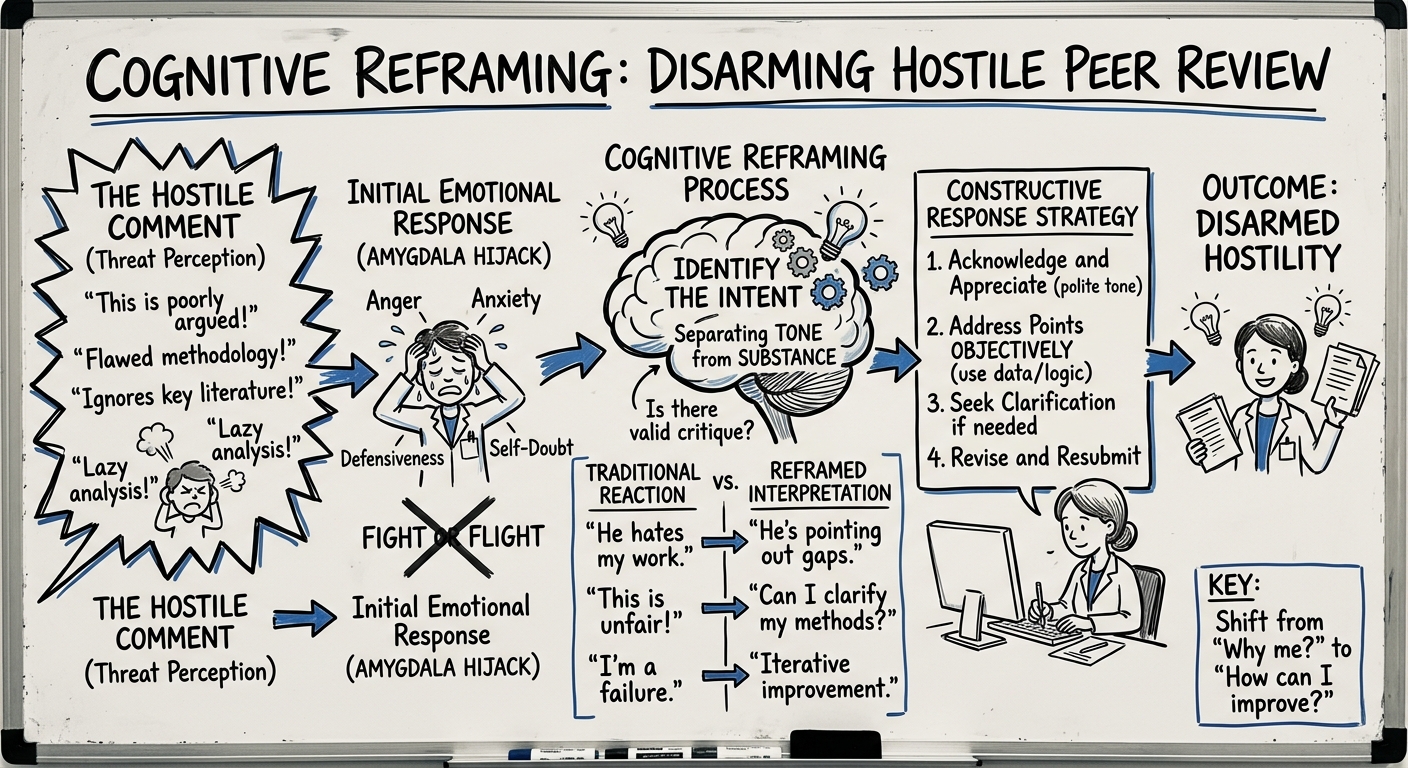
Every academic researcher—whether a first-year PhD student or a tenured professor—knows the visceral reaction that accompanies opening a decision letter. While constructive criticism is the lifeblood of the scientific process, we have all encountered the dreaded "Reviewer 2": the reviewer whose comments are unnecessarily harsh, dismissive, or seemingly hostile.
When faced with an aggressive critique, our natural instinct is to become defensive. We want to write a rebuttal that meticulously dismantles the reviewer's argument, proving our intellectual superiority. However, from a strategic standpoint, this is rarely the optimal approach. The peer review response process is not merely a scientific debate; it is a highly nuanced psychological negotiation.
In this article, we will explore a genuinely "cool" and highly effective approach to handling manuscript revisions: applying cognitive reframing and linguistic politeness theory to disarm hostile reviewers. By understanding the psychology behind peer review, you can transform adversarial interactions into collaborative discussions, dramatically increasing your chances of acceptance.
The Anatomy of a Hostile Review
Before we can effectively disarm a hostile reviewer, we must understand why they are hostile in the first place. Rarely is a harsh review a personal attack, even if it feels uniquely targeted. Instead, reviewer hostility is typically the product of three compounding psychological factors:
1. The Online Disinhibition Effect
In digital spaces, anonymity predictably leads to a reduction in interpersonal empathy—a phenomenon known in psychology as the online disinhibition effect. Blind peer review, while essential for minimizing bias, creates a structural environment where reviewers feel insulated from the social consequences of their words. They type things they would never say to your face at a conference poster session.
2. Reviewer Fatigue and Cognitive Depletion
Reviewers are your peers. They are overworked academics evaluating your manuscript on a Sunday afternoon, likely uncompensated, while juggling their own grants, teaching loads, and administrative duties. Cognitive depletion makes individuals more irritable and less likely to engage in the mental effort required to phrase critiques diplomatically.
3. The "Gatekeeper" Identity
When assigned the role of "reviewer," academics unconsciously adopt a gatekeeping identity. Their perceived mandate is to find flaws. If they find no flaws, they may feel they have failed in their duty to the journal. Consequently, minor issues are sometimes magnified to justify the reviewer's role in the process.
Understanding these factors is the first step in cognitive reframing. The reviewer's tone is not a reflection of your worth as a scientist; it is a byproduct of a flawed, high-stress system.
The "Cool" Science: Politeness Theory in Peer Review
To craft a successful response to a hostile reviewer, we can borrow a concept from sociolinguistics: Politeness Theory, originally developed by Penelope Brown and Stephen Levinson.
At the core of Politeness Theory is the concept of "face." Every individual has a "positive face" (the desire to be appreciated, validated, and respected) and a "negative face" (the desire to be free from imposition).
When a reviewer criticizes your work, they are attacking your positive face. When you disagree with a reviewer in your rebuttal, you are committing a "Face-Threatening Act" (FTA) against them. If you bluntly tell a reviewer they misunderstood your methodology, you threaten their positive face (their identity as a competent expert). If you threaten a reviewer's face, they will unconsciously dig their heels in and recommend rejection to protect their ego.
Therefore, the "cool" trick to writing a flawless rebuttal is learning how to disagree with a reviewer's scientific premise without threatening their face.
Here are four actionable tactics to achieve this.
Tactic 1: Cognitive Reframing and the "Yes, And" Approach
Cognitive reframing involves consciously changing the way you interpret a situation. Instead of viewing the reviewer as an adversary trying to sink your paper, reframe them as a brilliant but confused collaborator who genuinely wants to improve your work.
When responding to a critique you disagree with, use the "Yes, And" framework borrowed from improvisational theater. First, validate the reviewer's positive face (the "Yes"), and then introduce your counter-argument as an expansion of their thought (the "And").
Example: The Methodological Attack
The Hostile Comment: "The authors' reliance on Method X is entirely outdated and renders the results highly questionable. Any serious researcher in this field has moved on to Method Y."
The Defensive Response (Face-Threatening): "The reviewer is incorrect. Method X is still widely used, as evidenced by Smith et al. (2022). Furthermore, Method Y is inappropriate for our sample size."
The Reframed Response (Face-Saving): "We thank the reviewer for raising this important point regarding recent methodological advancements, and we completely agree that Method Y represents the cutting edge of the field. While we strongly considered Method Y, we ultimately retained Method X for this specific dataset because of its robustness with smaller sample sizes (Smith et al., 2022). To address the reviewer’s valid concern, we have added a section to the Discussion explicitly comparing the limitations of Method X versus Method Y."
Why it works: You validated their expertise (they know about Method Y). You agreed with their premise (Method Y is great). But you held your ground on your methodology by providing a scientific justification, rather than an emotional defense.
Tactic 2: Neutralizing Emotional Language Through Paraphrasing
Hostile reviewers often embed their scientific critiques in emotional or hyperbolic language. Your job is to act as a linguistic filter. When you write your response document, do not quote their hostility back to them. Instead, paraphrase their rant into a polite, objective scientific query.
Example: The Aggressive Critique
The Hostile Comment: "The discussion section is a complete mess. The authors make wild, unsubstantiated leaps of logic regarding the role of Protein Z, completely ignoring the basic biochemical constraints of the pathway."
The Reframed Response: "Reviewer Comment: The reviewer noted that the discussion regarding the role of Protein Z could be interpreted as overly speculative and requested tighter integration with established biochemical constraints.
Response: We appreciate the reviewer's careful reading of our discussion. We agree that our initial phrasing may have overstated the direct mechanistic role of Protein Z. In response to this helpful feedback, we have significantly revised paragraphs 3 and 4 of the Discussion to temper our conclusions and more clearly align our hypothesis with established pathway constraints."
Why it works: By summarizing their comment objectively, you remove the emotional heat from the document. The editor sees a rational, professional author gracefully handling a difficult reviewer. Furthermore, when the reviewer reads your polite summary of their angry comment, they often experience a subtle sense of professional embarrassment, making them more amenable to your revisions.
Tactic 3: Managing "Epistemic Trespassing"
"Epistemic trespassing" occurs when a reviewer who is an expert in one domain evaluates a paper that overlaps with another domain, and they confidently make incorrect assertions about the field they know less about. This is incredibly common in interdisciplinary research.
When a reviewer commits epistemic trespassing, correcting them is a massive Face-Threatening Act. They think they are right, and telling them they are ignorant of the literature will trigger a defensive rejection.
To handle this, use the "Blame the Manuscript" strategy. Assume the posture that if the reviewer misunderstood the concept, it is strictly because you, the author, failed to explain it clearly enough.
Example: Epistemic Trespassing
The Hostile Comment: "The authors fundamentally misunderstand Theory A. Theory A requires condition B to be true, which is absent here." (Note: The reviewer is wrong; Theory A does not require condition B in this specific sub-field).
The Reframed Response: "We are grateful to the reviewer for highlighting this point. We realize now that our original manuscript did not clearly delineate the specific application of Theory A being utilized in this context. While classical applications of Theory A require condition B, recent adaptations in this specific sub-field (Jones, 2021) have demonstrated its efficacy without condition B. We sincerely apologize for this lack of clarity. We have significantly revised the introduction (Page 4, Lines 112-118) to explicitly define our theoretical framework and cite the relevant literature, ensuring future readers do not share this confusion."
Why it works: You take the blame for their misunderstanding. You allow them to save face by suggesting that anyone would have been confused by your original, "poorly written" draft. You sneak the correction into the manuscript under the guise of "clarification."
Tactic 4: The Strategic Concession (The Sacrificial Lamb)
Negotiation experts know that to win the war, you must be willing to lose a few battles. In peer review, this translates to the "Sacrificial Lamb" strategy.
Reviewers need to feel that they have had a tangible impact on the manuscript. If you push back on every single point, they will feel ignored and disrespected. To protect your core findings, you must actively look for minor, inconsequential critiques that you can enthusiastically concede.
Did the reviewer suggest citing three of their own papers? Cite them. Did they suggest a minor supplementary experiment that takes two days but adds little value? Do it. Did they suggest changing a perfectly fine figure to a different color scheme? Change it.
When you concede these minor points, do so loudly and graciously in the response document.
"We thought this was a brilliant suggestion by the reviewer, and we have entirely restructured Figure 3 to align with this vision."
By feeding the reviewer's ego on minor points, you build a reservoir of goodwill. When you reach the major critique where you must disagree and hold your ground, the reviewer is already primed to view you as cooperative and reasonable.
Building a Resilient Response Workflow
Implementing these psychological strategies requires discipline. When you receive a difficult set of reviews, follow this three-step workflow to ensure you maintain a professional, academic tone:
Step 1: The Venting Draft (Do Not Send)
Read the reviews. Open a blank document. Write the most sarcastic, defensive, and petty response you can imagine. Get all of your anger out on the page. Call out the reviewer's lack of reading comprehension. Venting is a healthy psychological release. Once finished, save the document, close it, and step away from your computer for at least 48 hours.
Step 2: The Translation Phase
Return to the reviews with a cool head. Create a structured table. In column A, paste the reviewer's comments. In column B, translate the emotional critique into a dry, bulleted list of actionable scientific tasks. Strip away the adjectives. What do they actually want you to do?
Step 3: The Politeness Pass
Draft your actual responses based on Column B. Before finalizing, read through your responses specifically looking for Face-Threatening Acts. Ask yourself:
- Did I validate the reviewer's expertise?
- Did I use "we agree" or "we appreciate" where appropriate?
- Did I take the blame for misunderstandings?
This is precisely where modern academic tools can be a game-changer. Using a platform like Peereply can help you automate the "Politeness Pass." Peereply is designed to help researchers structure their responses, ensuring that the tone remains strictly professional, objective, and aligned with the best practices of peer review negotiation. It acts as an objective third party, helping you reframe your scientific defense into a diplomatic, face-saving response that editors and reviewers appreciate.
Conclusion
Peer review is not a purely objective evaluation of scientific merit; it is a human process, deeply influenced by psychology, ego, and emotion. By recognizing the structural factors that lead to reviewer hostility and actively employing cognitive reframing and politeness strategies, you can take control of the narrative.
Remember, your goal is not to prove the reviewer wrong. Your goal is to get your paper published. By treating hostile comments not as attacks, but as opportunities for strategic negotiation, you protect your peace of mind, accelerate your publication timeline, and master one of the most critical, yet rarely taught, skills in academia.